 +80°F
+80°F


OPINION: You Don’t Have to Pledge Loyalty to a Broken System
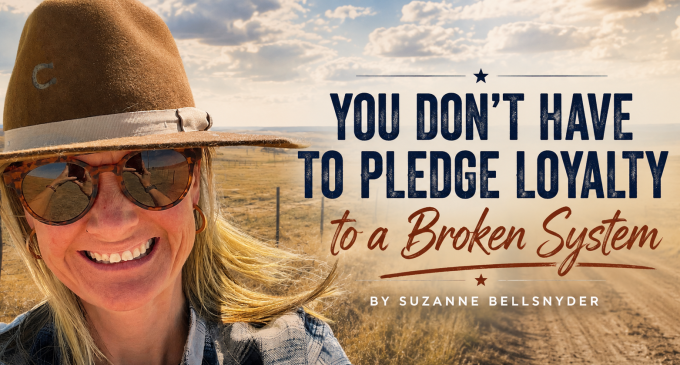
SUZANNE BELLSNYDER – The Rural Reporter
This report was originally published on Substack on May 27, 2026 which can be found here.
The results out of Texas last night told us something we already knew but didn’t want to say out loud: the two-party system is broken. And the primary process that’s supposed to give voters a choice has instead handed us a slate of candidates that even the most loyal Republicans I know can’t stomach.

I am a Republican. I have worked for Republicans, volunteered for Republicans, and voted for Republicans my entire adult life. I did that because the Republicans I knew shared my values — on the issues and on the basic question of integrity. I cannot say that about some of the people whose names will appear next to the R on my ballot this November.
So what’s a girl to do?
The system, not the movement
Here is what every Republican in Texas needs to sit with this morning.
Texas has 18.6 million registered voters — a record high.
About 2.17 million Texans voted in the March 3 Republican primary for U.S. Senate. Twelve weeks later, in the runoff that actually decided the nominee, that number collapsed to roughly 1.39 million — a 36% drop-off.
Paxton won 64% of those 1.39 million. Do the math: roughly 886,000 Texans — fewer than 5% of the state’s 18.7 million registered voters — just picked the Republican nominee for U.S. Senate.
On the other side of the ballot, the numbers were not impressive either. 2.3 million Texans voted in the Democratic primary in March. James Talarico won his nomination outright with 52% — roughly 1.2 million votes, or about 6.4% of registered Texans.
Add it up. The next United States Senator from Texas will be one of two people chosen by about 11% of registered Texans. Eighty-nine percent of us had no say in narrowing the field. Now, here is the part I want to be very clear about, because it is easy to get wrong.
The problem is not MAGA. The problem is not Ken Paxton. The problem is not PACs funded by donors like West Texas billionaire Tim Dunn. The problem is not any one candidate, one donor, or any one movement.
The problem is the system.
It is convenient to say “MAGA or Dunn or Paxton took over the Republican Party.” It is also lazy. They did not break the primary system. They found a broken primary system and did exactly what any well-funded, organized, motivated faction would do with it — they strategized, they showed up, they turned out, and they won. Twice. With fewer than 5% of registered Texans behind them.
A system that hands the steering wheel to whichever faction can mobilize the most committed slice of the smallest electorate is going to keep producing factional candidates. If it’s not MAGA, it will be the next movement. If it’s not Paxton, it will be the next Paxton. The faces change. The math does not.
What the system rewards
Once you see this clearly, the rest of last night’s result stops being a mystery and starts being a pattern.
The system rewards the most extreme candidate, not the best one. Primaries with single-digit turnout reward whoever can mobilize the angriest, most ideologically committed slice of the base. That isn’t democracy. That’s a caucus dressed up as an election.
Money alone doesn’t win — organized money does. Cornyn’s allies outspent Paxton’s something like three-to-one when you count satellite groups. He still got crushed. Why? Because Paxton’s people were organized, motivated, and tied into a grassroots network that has been building for a decade. A billionaire donor from West Texas has a louder voice than a working voter in Hansford County or Cass County — and not just because of the check he writes, but because of the operation that check has built.
There is no credible source of information for the regular voter. Local newspapers have shrunk or closed. Voters are left with pay-to-play scorecards, campaign ads, social media, and whatever their cousin shared on Facebook. The result is a “vote them all out” mentality that delivers exactly what we just got.
We’ve decided “weird” is a bigger disqualifier than “corrupt.” Faced with a candidate accused of corruption and a candidate we see as “not conservative” enough, the base picked the one accused of corruption. Every time. Why does that work? Because the system has trained voters to see “loyal to our side” as the only virtue that matters. Once “loyal” becomes more important than “honest,” corruption stops being disqualifying. It becomes evidence the candidate is fighting hard enough to make enemies.
And now, the morning after, the leadership of the Texas Republican Party is gathering itself together and asking us all to forget every accusation, every indictment, every controversy, every bit of opposition research the Cornyn campaign spent millions pumping into our living rooms — and pledge our fealty to the party brand.
That’s where I get off the bus.
A word to my fellow Republicans
I want to talk to the people reading this who feel the same knot in their stomach I do this morning.
You know who you are. You voted in the primary. Maybe you voted for Cornyn. Maybe you voted for Hunt. Maybe you held your nose and voted for Paxton because you’d been told he was the more “conservative” Republican. Either way, you are looking at this November ballot and something in you is recoiling.
And then a quieter voice in your head says: But I’m a Republican. I have to vote the ticket.
I want to take that voice seriously for a minute, because it isn’t a stupid voice. It’s the voice of every family Thanksgiving, every Sunday school class, every business relationship, every community board you’ve ever served on. It’s the voice that tells you who your people are. It is doing real work for you, and I’m not going to pretend otherwise.
But I want to ask you a harder question. What are you actually being loyal to?
You are not being loyal to the candidate. You don’t know him. He’s never visited your part of the world. You probably don’t like him. I might even argue he didn’t earn your vote and the votes he did manage to get were few and far between in the great scheme of things.
And frankly, the Republican party as you understood it — the party of Reagan, of limited government, of personal integrity, of character mattering — is not what’s on the ballot this November. The brand is the same. The candidates have changed.
I am asking you to think long and hard about this.
f your values are integrity, character, and showing up to do the job, then a vote for a candidate who fails those tests is a vote against your values, not for them.
So if you don’t align with these candidates on the values that matter most to you, what are you pledging your loyalty to?
Is it habit? The muscle memory of forty years of pulling the same lever?
Is it the discomfort of doing something different — the strangeness of standing in that booth and making a choice you’ve never made before?
Or is it the quiet fear that the alternative — voting independent, splitting your ticket, skipping a race — would feel worse than swallowing hard and pulling the lever one more time?
I am here to tell you it doesn’t.
Permission
This is Texas. Independence is supposed to be our defining value. Somewhere along the way, “Republican” and “Texan” got tangled up in people’s heads until they felt like the same word. They aren’t. They never were.
You can be a Republican and vote independent in a single race. You can be a Republican and skip a race that turns your stomach. You can be a Republican and vote for the candidate whose priority is public education, if that’s the issue you care about the most. You can be a Republican and split your ticket. None of that makes you a Democrat. None of that makes you disloyal.
When you walk into the voting booth and make your private choices, no one knows your vote except you. And you are still a Republican because YOU get to decide that – no one else – and it’s really nobody’s business unless you want to tell them.
What it means is that you took your vote — your one vote, the one thing the system cannot take from you — and you used it for the thing it was designed for. Your judgment. Your conscience. Your values.
That is not a betrayal of the Republican Party. Voting against your values to protect a brand is the betrayal. The party you grew up in did not ask you to do that. The party you grew up in told you character mattered. If the people running the party have forgotten that, the answer is not to forget it with them.
There are good candidates on the November ballot — qualified, principled people running for offices up and down the ticket. There are also a couple of candidates who are not fit for the offices they are seeking, and you know which ones I mean. You don’t owe them your vote. You owe your vote to the person who actually deserves it, regardless of the letter after their name.
Vote your conscience on those races. Vote independent where there’s a credible independent. Leave a race blank if you have to. The R does not own you. Your vote is yours.
The hard truth
We are all scratching our heads this morning asking what the heck happened. The truth is, we never had a chance. The system is flawed. It gives more weight to money than to voters. More weight to organized factions than to honest citizens. More weight to the loudest voice than to the most thoughtful one.
The people didn’t decide this. The system did.
And the only thing that stops the system from doing this again — in 2028, in 2030, in every election after that — is when enough of us decide that our loyalty belongs to our values, not to a letter on a ballot.
I woke up early this morning like I always do, and after one cup of strong black coffee, I made my decision. I’d encourage you to make yours.
Discover more from Mineral Wells Area News
Subscribe to get the latest posts sent to your email.





…. so, what is “your” alternative?
Are you going to show those “rich” Republicans by hot voting, or worse, by voting …. Democrat?
Or, will you do what the rest of us commoners do, vote Republican.
This is the United States of America. You have choice.
Your opinion is your opinion, but where is your outrage at poor voter turnout?